
Learn Arabic Online For Free
Start your journey to fluency with free Arabic lessons from the Nassra Arabic Method, founded by Omar and Khaled Nassra. We provide proven strategies to learn Arabic correctly and efficiently, whether your goal is conversational fluency in Levantine/Gulf dialects or professional Business Arabic.
Why Learning Media Arabic (MSA): Essential Arabic Vocabulary

For those learning Arabic, diving into the world of news in Arabic isn't just about words and grammar. It opens up a whole new set of advantages that make the learning process more exciting and relevant. In this article, we'll look at why learning Arabic through news is so important and what benefits it brings to learners.
Real-Life Talk:
Arabic news is like eavesdropping on real conversations. By reading news articles and watching news reports, you get used to how people actually speak Arabic...
The quickest Way to Learn Arabic - The Best Learning Arabic Method

In this article, I aim to address the most commonly asked questions about learning Arabic and provide valuable tips to enhance your language skills, whether you're a beginner, have paused your learning journey, or are progressing toward fluency. Drawing from my 15 years of teaching experience, I will share insights into my teaching methodology and offer guidance on where absolute beginners should commence their Arabic learning journey. Additionally, I'll introduce a novel philosophy on seamlessl...
Arabic Dialects vs. Modern Standard Arabic (MSA)
Choosing the Right Arabic for You: Dialects vs. Modern Standard Arabic (MSA)
When it comes to learning Arabic, it's important to understand the distinction between Modern Standard Arabic (MSA) and Arabic dialects. While MSA is the formal written and spoken Arabic used in media and literature, Arabic dialects are the everyday spoken languages in specific regions.
Modern Standard Arabic (MSA):
Modern Standard Arabic is the standardized form of Arabic used in formal settings, such as news bro...
Arabic Verb Conjugation |Top 100 Past Tense Verbs | Learn Arabic Online

Understanding the Basics: Arabic Past Tense vs. English
Learning how to conjugate verbs in the past, present and future is the most crucial aspect of mastering the Arabic language. Arabic verb conjugation can be challenging, especially if your native language is English, as this concept is not present in the English language.
Overcoming Challenges in Arabic Verb Conjugation for English Speakers
To conjugate the verb "to write" in English present tense, you just need to change the pronouns bef...
A Step-by-Step Guide for Mastering 100 Levantine Arabic Verbs Conjugation for Beginners

Learning Arabic is an exciting and rewarding journey. However, mastering verb conjugation can be a challenge. Don't let the intricacies of verb conjugation discourage you from .
In this article, I'll guide you through an essential aspect of Arabic grammar – conjugating the first 100 verbs in the present tense, focusing specifically on the first person (I form). Before delving into this, it's crucial to understand a fundamental concept that can significantly impact your language learning experie...
Essential Levantive Arabic Verbs for Beginners: A1-A2 Level Arabic Vocabulary List

Learning a new language is a thrilling endeavor, and for beginners delving into the Arabic language, understanding the fundamentals is key. This article titled "Essential Arabic Verbs for Beginners: A1-A2 Level Vocabulary List" serves as an invaluable resource for those navigating the initial stages of Arabic language acquisition.
At the heart of Arabic language learning lies the significance of grasping the roots of verbs, especially for individuals at the A1 and A2 proficiency levels. This un...
Mastering The Simple Present Tense or "بـ" (bi) Form in Levantine Arabic: A Comprehensive Guide

Learning Levantine Arabic opens the door to a rich linguistic tapestry, and one of its essential components is the simple present tense, commonly expressed using the "بـ" (bi) form.
In this article, we will delve into the intricacies of when to use "بِشْتِغِل" (bishtighil), "باُكُل" (bakul), "بِحْكي" (bihki), and when to opt for the "اِشْتِغِل" (ishtighil), "آكُل" (akul), "اِحْكي" (ihki) forms. Additionally, we'll explore scenarios where these forms are complemented by auxiliary verbs such as "...
How to Conjugate The Verb of "اِشْتَغَل" in Both The Past and Present Tense Levantine Arabic

The verb "اِشْتَغَل" (ishtaghal) plays a vital role in Levantine Arabic, reflecting the dynamic nature of life and work in the Levant region. This verb, meaning "to work," is used extensively in various contexts, from professional settings to daily life. In this article, we will delve into the conjugation of "اِشْتَغَل" in both the past and present tenses, explore examples of its usage, and discuss why mastering this verb is crucial for effective communication in Levantine Arabic.
How to Conjug...
Step-by-Step Guide on How to Conjugate Arabic Verbs in the Present Tense

Mastering the present tense conjugation of Arabic verbs requires understanding the subject pronoun and applying the right conjugation for the root verb. The Arabic language relies on a three-letter root system, and these roots are combined with specific patterns to create fully conjugated verbs. With this knowledge, you'll be able to confidently communicate with native Arabic speakers and deepen your understanding of Arabic literature and culture.
Here's a step-by-step guide on how to conjugate...
Modern Standard Arabic (MSA)
Modern Standard Arabic (MSA):
MSA is the standardized form of Arabic used in formal settings such as literature, media, education, and official communication. In this article, we will explore the significance of MSA and its role in connecting Arabic speakers across different dialects.
Defining Modern Standard Arabic:
Modern Standard Arabic, also known as Literary Arabic or Standard Arabic, is the standardized form of the Arabic language. It is based on Classical Arabic, the language of th...
Learn Arabic Online With Nassra Arabic Method
6-Month Online Membership.
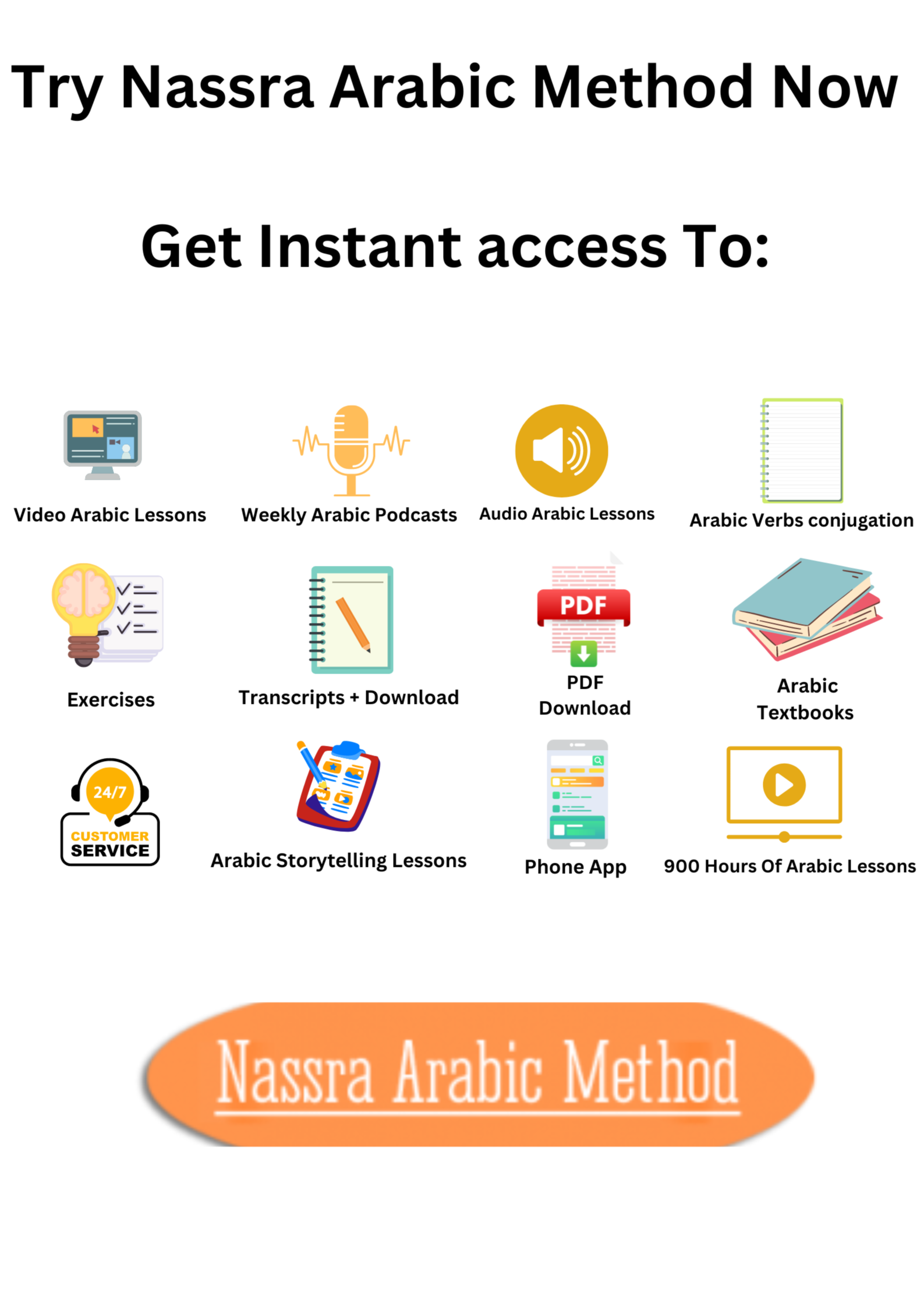
Gain access to over 900 hours of content, including a 4K video library, audio Arabic lessons, and podcasts. Our carefully curated lessons cover a wide range of topics, allowing you to master the intricacies of Levantine and Gulf Arabic dialects. With downloadable transcripts, you can study at your own pace, anytime, anywhere.
Recent Posts
